7 min read
Your Bullhorn Career Portal Is Costing You Candidates.
The official Bullhorn Career Portal hasn't been updated in years. We built a modern, fully customizable alternative, self-hosted or fully managed.

Your Bullhorn Career Portal Is Costing You Candidates. Here's What to Do About It
Let's be honest. If you're running the official Bullhorn Career Portal, your candidates are getting a worse experience than they'd get on most job boards built this decade.
The project started roughly ten years ago on Angular 10.2.4, a version that hit end-of-life in December 2021. Angular is now on v19. That's nine major versions behind. The runtime is pinned to Node.js 16.13.1, which itself went EOL in September 2023. It still relies on ngcc, the Angular Compatibility Compiler that was deprecated and fully removed in Angular 16.
After the v3.5.0 release in May 2022, the project went effectively dormant. Nearly four years of silence.
The portal ships with Google Analytics Universal baked in, which Google sunset in 2023. The demo site isn't even a working portal. It's a static Jekyll documentation page hosted on GitHub Pages. If you inspect the analytics section, you'll find a lonely <!-- Setup Google Analytics --> HTML comment with no actual tracking code. That tells you everything.
Because it's an Angular single-page application, search engines see an empty shell. Your jobs don't get indexed properly. The design options are limited, the look feels dated, and customization requires wrestling with a framework that's nearly a decade old.
Why This Actually Matters for Your Business
This isn't about chasing trends or rewriting things for fun. It's about not leaving money on the table.
Your career portal is the first touchpoint for most candidates. It's your storefront. When a candidate clicks through from LinkedIn, Google, or a referral, the portal is where they decide whether your agency looks credible enough to submit an application. If what greets them feels like a relic from 2016, they bounce. Straight to a competitor or a generic job board.
Poor SEO compounds the problem. An Angular SPA that renders an empty page on first load means Google can't index your job listings properly. Your positions don't show up in search results. Candidates who would've found you organically never even know you exist.
Mobile experience is another sore spot. Open issue #473 documents formatting problems on mobile devices, and it's been sitting there unresolved. Consider that the majority of job seekers browse on their phones. Every broken layout or awkward scroll is a candidate who doesn't finish their application.
Then there's the analytics blind spot. Without working, modern analytics, you have no idea where your candidates come from, where they drop off, which jobs get the most views, or what's actually converting. You're making decisions about your candidate pipeline based on gut feeling.
The bottom line: an outdated career portal means fewer applications, lower-quality candidates, and missed placements. Every month it stays this way is revenue you're not capturing.
What a Modern Career Portal Actually Looks Like
If you were building a career portal from scratch today, with no legacy baggage, here's what it would include.
Fully Customizable Design
Your career portal should look like a natural extension of your website, not a bolted-on widget from another era. Brand colors, typography, layout: everything should match.
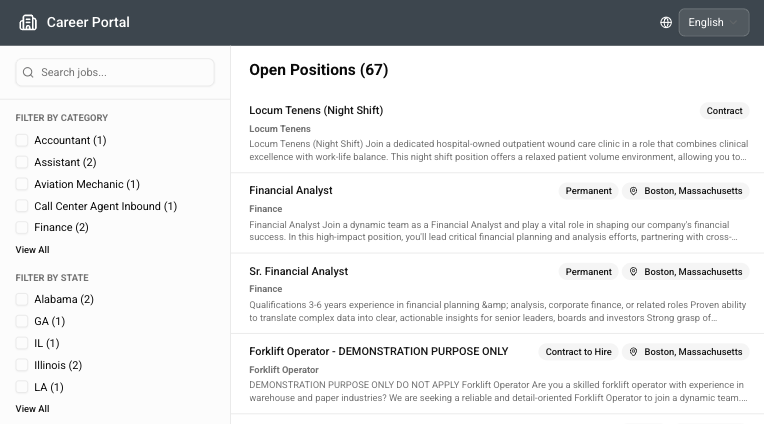
Compare that to what's possible with a purpose-built solution:
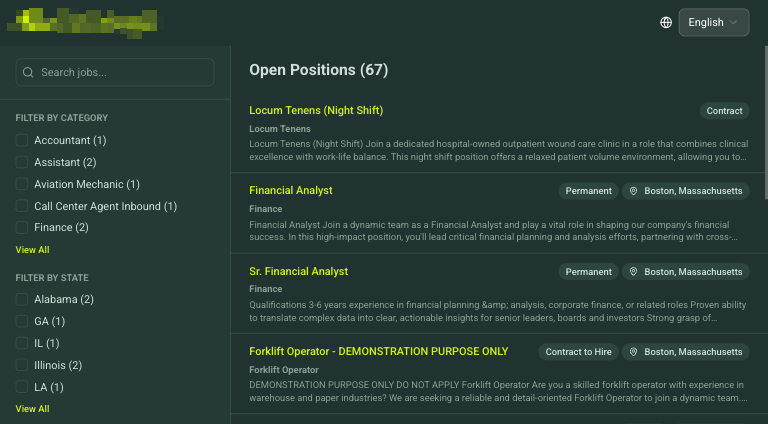
The difference isn't cosmetic. It's the difference between a candidate trusting your brand and clicking away. First impressions happen in seconds, and design is the first thing people judge, before they ever read a job description.
Built for SEO from Day One
Every job listing should live on its own indexable page with proper meta tags, structured data, and server-side rendering. Built with a framework like Next.js, each page loads fully rendered HTML that search engines can crawl immediately. No waiting for JavaScript to hydrate an empty shell. Your jobs show up in Google, and candidates find you without needing a direct link.
Modern Analytics
GA4, Mixpanel, PostHog, whatever your team already uses. Real conversion funnels, source tracking, job-level engagement metrics. You should know exactly which channels bring candidates, which job listings get the most views, and where people drop off in the application flow. Data-driven recruiting starts with actually having the data.
Multi-Language Support
Not just translating button labels. Full localization: job descriptions, page content, URL structures, metadata, all served in the candidate's language. Critical for agencies operating across regions or in multilingual markets like Canada, Belgium, or Switzerland.
Direct Bullhorn Integration
Jobs fetched in real time via Bullhorn's public API. When a candidate applies, their information and resume go straight back into Bullhorn. No middleware, no CSV imports, no manual data entry. Your recruiters see the application the moment it lands.
AI-Powered Resume Parsing
Candidates upload a resume and it's parsed automatically. The default Bullhorn parser handles standard formats well, but an advanced AI parser takes it further: extracting all sections, preserving formatting, handling non-standard layouts, and even reformatting content to match a consistent voice and tone. We'll be doing a dedicated deep-dive on resume parsing in an upcoming post.
Extensible Integrations
Email notifications when new applications arrive. Slack or Teams alerts for your recruiting team. Webhooks that let you plug into any workflow you've already built. The portal shouldn't be a dead end. It should be a starting point.
Deploy Anywhere
AWS, GCP, Azure, Vercel, Cloudflare, on-premise. Your infrastructure, your rules. No vendor lock-in, no forced hosting arrangement. If your compliance team requires data to stay in a specific region or on your own servers, that's fully supported.
We Built This, and Here's How You Can Get It
We didn't just write about what a modern career portal should look like. We built one. At Achieve, we've taken every capability listed above and shipped it as a production-ready platform that plugs directly into Bullhorn.
There are two ways to run it, depending on how hands-on you want to be.
Option 1: Self-Hosted
Deploy it on your own cloud infrastructure (AWS, GCP, Azure) or on specialized platforms like Vercel or Cloudflare. You control the infrastructure, the data, and the update cycle. Your team manages deployments and can customize as deep as they want. This option works well for agencies with in-house developers or an existing DevOps setup.
Option 2: Fully Managed by Achieve
Don't have a developer on staff? Don't want to manage infrastructure? We handle everything: deployment, hosting, updates, monitoring, and ongoing support. You point your domain at us, and we take care of the rest. No servers to manage, no deployments to coordinate. You get a modern career portal without adding operational complexity.
Both options integrate cleanly with your existing website, whether it's built on WordPress, a custom CMS, or something else entirely. We're also building a sync engine that bridges your main site and the portal seamlessly. Learn more about it.
Stop Losing Candidates to a Portal That Hasn't Been Updated in Years
Every month your career portal stays outdated is another month of candidates bouncing, applications dropping off, and jobs sitting invisible on Google. The data you're not collecting is decisions you can't make. The candidates you're not reaching are placements your competitors are closing.
The fix isn't complicated, and it doesn't require a six-month project. You don't need to rip out your ATS or change how your recruiters work.
Book a 15-minute call and we'll show you what your career portal could look like with your branding, your jobs, and your Bullhorn data, live.
Not ready to talk yet? That's fine. Check out the official portal's GitHub repo yourself. The commit history tells the whole story. Thirty-nine open issues, some dating back nearly ten years. A pull request sitting unmerged for two and a half years. Five active contributors in the last two years. When you're ready to move on from that, we'll be here.